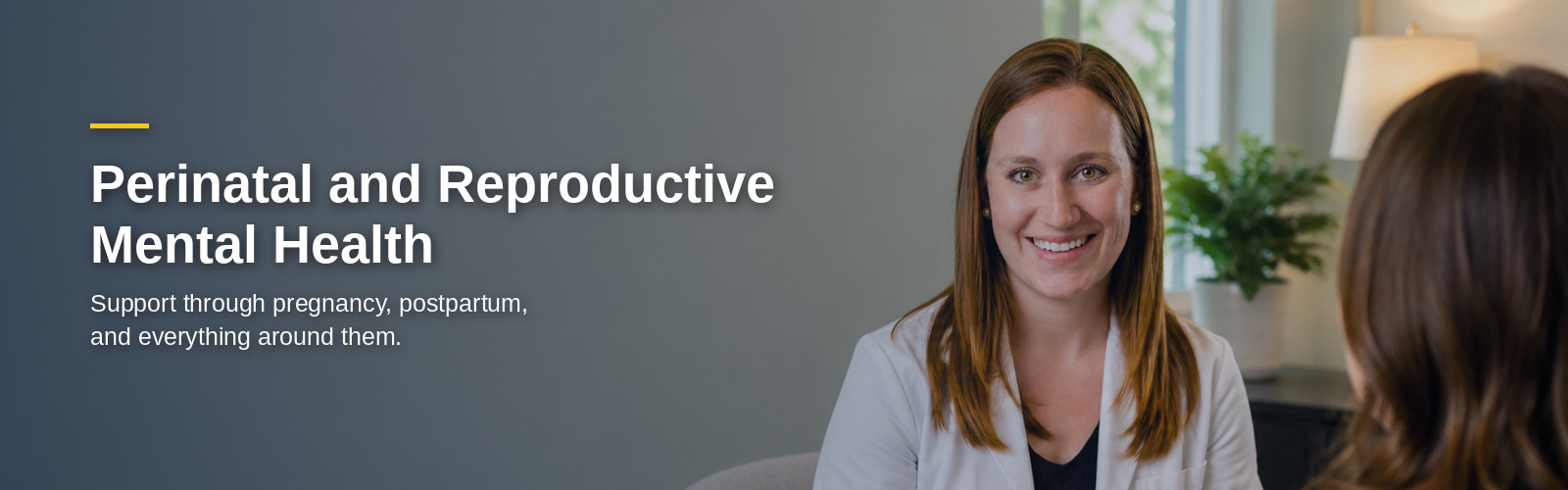
The season around pregnancy and new parenthood is supposed to be a joyful one. For many people it is also exhausting, isolating, and far harder emotionally than anyone warned them it would be. If that has been your experience, it does not mean you are doing this wrong, and it does not mean you love your family any less.
A Ray of Hope offers therapy and psychiatric care for people navigating fertility, pregnancy, postpartum, loss, and the other transitions of reproductive life. You can be seen in person at our locations or by telehealth, which many new parents find far easier to manage during the first year.
What Perinatal and Reproductive Mental Health Means
Perinatal refers to the stretch of time that begins when you start trying to conceive, runs through pregnancy, and continues well into the first year or two after a baby arrives. Reproductive mental health is broader still, covering emotional health across the whole reproductive lifespan, from menstrual cycles through menopause.
Mood and anxiety conditions are among the most common complications of pregnancy and childbirth. Roughly one in eight people who have recently given birth report symptoms of postpartum depression, and many more live with anxiety, intrusive thoughts, or trauma responses that never get named out loud. These conditions are treatable, and with the right support many people begin to feel better sooner than they expected.

Dr. Jennifer Laflamme, DO
BOARD CERTIFIED PSYCHIATRIST
Dr. Laflamme leads reproductive mental health care at A Ray of Hope. She has advanced training in perinatal and reproductive psychiatry, and her practice centers on people navigating the reproductive life span, from preconception and pregnancy through postpartum, infertility, pregnancy loss, and perimenopause.
She completed medical school at Lake Erie College of Osteopathic Medicine and residency at Lutheran General Hospital in Park Ridge, Illinois. She offers medication management, psychotherapy, and EMDR, and she works in a trauma informed way that keeps you in charge of the decisions.
She is listed in the Postpartum Support International provider directory and is accepting new patients.
Signs It May Be Time to Reach Out
There is no threshold you have to cross before you are allowed to ask for help. If any of these have been true for more than a couple of weeks, a conversation with a provider may be worth having.
Sadness or emptiness that will not lift
Anxiety, racing thoughts, or constant dread
Scary or intrusive thoughts that frighten you
Feeling detached from your baby or from yourself
Anger or irritability that feels out of character
Trouble sleeping even when the baby is asleep
Guilt, or a sense that you are failing at this
Replaying a difficult birth or fertility experience
Pulling away from people who care about you
Losing interest in things you used to enjoy
Upsetting, intrusive thoughts are far more common in this period than most people realize, and having them does not mean you want to act on them. They are a recognized symptom, they tend to respond well to treatment, and providers who work in perinatal care hear about them often.

What We Help With
Pregnancy and postpartum
Depression, anxiety, panic, intrusive thoughts, and the difficult adjustment that can come during pregnancy and in the first year after birth.
Fertility, loss, and grief
The strain of fertility treatment, pregnancy loss, infant loss, and grief that the people around you may not know how to acknowledge.
The wider reproductive span
Birth trauma, premenstrual mood changes, and the emotional shifts that can arrive with perimenopause and menopause.

How We Help
Care during this season should fit the reality of your days rather than add one more thing you have to manage.
Individual therapy with perinatal experience
EMDR therapy for birth trauma or loss
Psychiatric evaluation and medication management
Careful review of options during pregnancy and nursing
Telehealth visits you can attend from home
Coordination with your OB, midwife, or pediatrician
Support for partners and for couples together
Care that continues as your needs change
If medication is something you are weighing, your provider will walk through what is currently known about the options during pregnancy and breastfeeding, including what it may mean to leave a condition untreated, so that the decision is an informed one and it stays yours to make.
Support for Partners and Loved Ones
Partners develop perinatal depression and anxiety too, and it often goes unrecognized because it tends to look different. Instead of sadness, it may show up as irritability, withdrawal, working longer hours, or shutting down entirely. If that sounds familiar, you are allowed to seek care for yourself, not only for the person you are supporting.
If you are the partner, parent, or friend of someone who is struggling, practical help usually lands better than advice. Taking a night feeding, handling a meal, driving to an appointment and sitting in the waiting room. You are also welcome to call us with questions about how to raise the subject with someone you are worried about.
If You Need Support Right Now
You do not have to wait for an appointment to talk to someone. These lines are free, confidential, and staffed around the clock.
988 Suicide and Crisis Lifeline. Call or text 988, any time, day or night.
National Maternal Mental Health Hotline. Call or text 1-833-852-6262, available 24 hours a day for pregnant and new parents and their families.
Postpartum Support International HelpLine. Call or text 1-800-944-4773. This is a support line rather than a crisis line, and a trained volunteer returns your message.
Some symptoms need same day attention. If you or someone you love is feeling confused or out of touch with reality, seeing or hearing things that others do not, or having thoughts of harming yourself or your baby, call 988 or go to the nearest emergency room. These symptoms are uncommon, they are treatable, and getting help quickly makes a real difference.
Why Choose A Ray of Hope
Care in this season is usually scattered across an OB for the body, a therapist somewhere across town, and a prescriber somewhere else again, with none of them talking to each other. When you are running on very little sleep, that fragmentation is its own burden. Our practice is built to hold it together.
Psychiatry and therapy under one practice
Providers familiar with perinatal presentations
Telehealth, so you do not have to leave the house
Medication questions answered by a prescriber
Coordination with your OB, midwife, or pediatrician
Care that continues past the first year if you need it
Ready When You Are
Choose the office nearest you to request an appointment, or give us a call and we will help you find the right provider.

© 2026 A Ray of Hope Neurology and Psychiatry. All rights Reserved - Accessibility Statement - Privacy Policy - Sitemap
Managed and Designed by 

NOW ACCEPTING NEW PATIENTS
Child and Adolescent Psychiatry
Board-certified child psychiatrist with appointment openings now!
Call (847) 816-6335 Meet Christian Schmidt, MD