EMG vs NCS: What's the Difference Between an EMG and Nerve Conduction Study?
If you have been referred for an EMG or a nerve conduction study, the terminology can be confusing. Are they the same test? Does one replace the other? And if your doctor has ordered both, does that mean something is seriously wrong?
The short answer is that EMG and nerve conduction studies (NCS) are different tests that examine different aspects of nerve and muscle function. They are often performed during the same appointment because the information from one can complement the other
Understanding that distinction can make the experience less intimidating—and can also help explain why your neurologist may recommend one test, the other, or both.
EMG vs NCS: The Basic Difference
An easy way to think about the two tests is this:
A nerve conduction study looks at how well electrical signals travel through your nerves.
An EMG looks at the electrical activity produced by your muscles.
NCS primarily evaluates the function of peripheral nerves by measuring factors such as how quickly a signal travels and how strong the resulting response is. EMG, particularly needle EMG, evaluates electrical activity within selected muscles, including activity when the muscle is relaxed and when it contracts: MedlinePlus.
That difference matters because numbness, weakness, tingling, cramps, or pain can have several possible causes. A nerve may not be conducting signals normally. A muscle may not be responding normally. A nerve root near the spine may be involved. Or the problem may affect the connection between nerves and muscles.
An electrodiagnostic evaluation helps a physician investigate those possibilities rather than simply assuming that a symptom has one obvious cause.
What Is a Nerve Conduction Study?
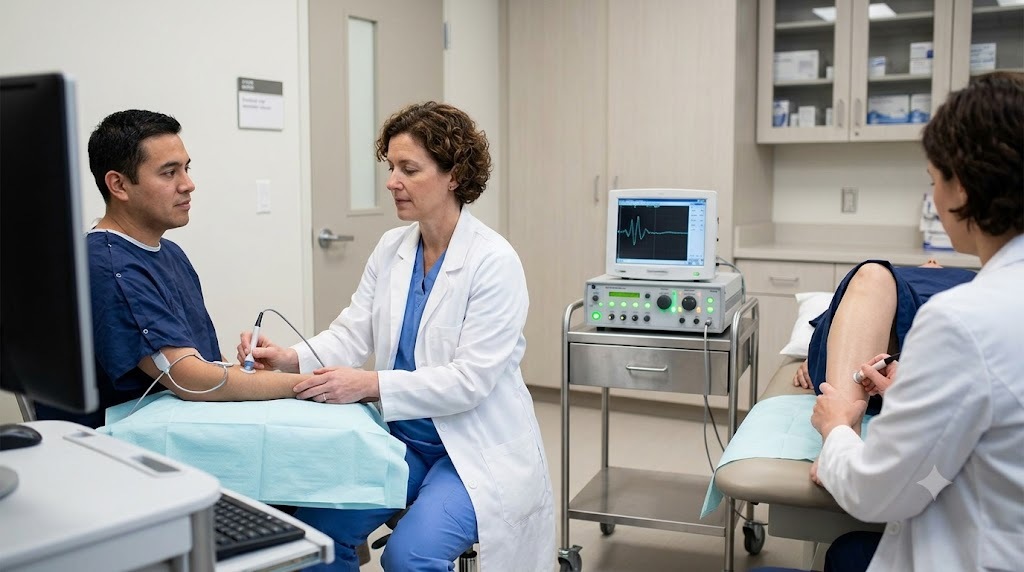
A nerve conduction study, often called an NCS or sometimes an NCV test, measures how electrical impulses move along peripheral nerves.During the test, small electrodes are placed on the skin. The nerve being examined is stimulated with a brief electrical pulse, and recording electrodes measure the response. The test can assess characteristics such as the time it takes for the signal to travel and the size of the response: AANEM.
You may feel a quick tingling or tapping sensation when the nerve is stimulated. The sensation is generally brief.
The results can help a neurologist determine whether a nerve is conducting signals normally and, when an abnormality is present, provide information about the type and location of nerve dysfunction.
NCS can be particularly useful when a doctor is evaluating suspected peripheral nerve problems, including conditions in which nerves are compressed or damaged.
For example, someone experiencing numbness and tingling in the hand may have symptoms caused by a nerve being compressed at the wrist. A nerve conduction study can provide objective information about how that nerve is functioning.
What Is an EMG Test?
Electromyography, or EMG, examines the electrical activity of muscles.
In a needle EMG, a physician inserts a very thin needle electrode into selected muscles. The electrode records electrical activity while the muscle is relaxed and during specific movements or contractions.
The physician can use those electrical signals to look for patterns that may indicate abnormal muscle or nerve function.
This is an important distinction: although people often use "EMG" as a general term for the entire examination, a complete electrodiagnostic evaluation can include both nerve conduction studies and needle EMG.
That is one reason you may hear a doctor or medical office refer to an "EMG test" even though your appointment includes several components.
EMG vs NCS: How Are They Different?
The simplest comparison is what each test is primarily designed to measure
| NCS | EMG |
Main focus | Peripheral nerve function | Muscle electrical activity |
How it is performed | Surface electrodes and brief electrical stimulation | Thin needle electrode placed into selected muscles |
What it measures | How nerve signals travel | Electrical activity within muscles |
What you may feel | Brief electrical pulses or tingling | Some discomfort from needle insertion and muscle contraction |
Often performed with | Needle EMG | Nerve conduction studies |
The two tests are therefore complementary rather than competing tests. MedlinePlus notes that
they can be performed separately but are usually performed together when both are needed
Why Are EMG and NCS Often Done Together?
The human nervous system does not work in isolated parts.
Nerves carry electrical signals. Muscles respond to those signals. If something goes wrong anywhere along that pathway, the resulting symptoms can look surprisingly similar.
Consider someone with weakness in an arm. The weakness could potentially involve a peripheral nerve, a nerve root, a muscle, or another part of the neuromuscular system. Looking at only one part of the system may not provide the complete picture.
That is where combining NCS and EMG can be useful.
The nerve conduction portion can show how well specific nerves conduct electrical signals. Needle EMG can then provide information about the electrical behavior of selected muscles. Together, these findings can help the physician determine whether the symptoms are more consistent with a nerve problem, a muscle problem, or another neuromuscular disorder.
The testing is also individualized. A physician does not necessarily need to test every nerve or muscle in the body. The examination is selected based on the patient's symptoms, medical history, physical examination, and the diagnostic questions the physician is trying to answer.
AANEM guidance emphasizes that electrodiagnostic evaluations should be tailored to the clinical problem.
When Might a Doctor Recommend These Tests?
An EMG test and nerve conduction study may be considered when symptoms suggest a problem involving nerves, muscles, or the connection between them.
Common symptoms that may lead to an electrodiagnostic evaluation include:
Numbness
Tingling or "pins and needles"
Muscle weakness
Muscle cramps
Muscle twitching
Certain types of limb pain
Unexplained changes in muscle function
These tests may help evaluate conditions involving peripheral nerves, nerve roots, muscles, or other parts of the neuromuscular system.
Importantly, the presence of these symptoms does not automatically mean that you need an EMG or NCS. The decision depends on the clinical situation and what your physician is trying to determine.
EMG vs NCS for Nerve Problems
One common misconception is that an EMG is simply a test for muscles and therefore has nothing to do with nerves.
In reality, muscle electrical activity can provide useful information about how nerves are affecting those muscles.
For example, when a nerve supplying a muscle is damaged or irritated, the electrical behavior of that muscle can change. Needle EMG can therefore contribute information that complements the nerve conduction findings.
This becomes particularly relevant when a physician is investigating problems that may originate closer to the spine or involve nerve roots. The combination of clinical examination, NCS, and EMG can help narrow down where along the nerve-muscle pathway the problem may be occurring.
That is why the question is not always "EMG or NCS?" In many cases, the more useful question is "What combination of electrodiagnostic tests will best answer the clinical question?"
Are EMG and NCS Painful?
This is probably one of the first questions people have after hearing the word "EMG."
Nerve conduction studies involve brief electrical stimulation. Most people describe the sensation as a quick shock, tingling, or tapping feeling. AANEM describes the stimulation as producing a quick, mild tingling sensation.
Needle EMG involves inserting a small needle electrode into selected muscles. There can be some discomfort during needle insertion and while the muscle is being evaluated. The number of muscles examined depends on the symptoms and the physician's diagnostic plan.
The examination is not intended to test every muscle or nerve. It is tailored to the problem being investigated.
Afterward, most people can return to their normal activities. AANEM notes that electrodiagnostic testing generally does not have lasting side effects.
What Happens During an EMG and Nerve Conduction Study?
When both tests are being performed, the nerve conduction study is generally completed first.
For the NCS portion, electrodes are placed on the skin, and the relevant nerve is stimulated. The response is recorded and analyzed.
If a needle EMG is also required, the physician then examines selected muscles using a small needle electrode. The physician may assess the muscle at rest and during activation.
The entire evaluation can vary in length depending on how many nerves and muscles need to be examined. AANEM states that electrodiagnostic testing commonly takes about 20 to 90 minutes, while MedlinePlus notes that the NCS portion can range from roughly 15 minutes to more than an hour depending on the scope of testing.
How Should You Prepare?
Preparation is generally straightforward, but it is worth following the instructions provided by your testing center.
Clean skin is important because lotions, creams, and other products can interfere with electrode placement or recordings. MedlinePlus recommends avoiding lotions, creams, or perfumes before testing.
Tell the physician or testing team if you have a pacemaker or implanted cardiac defibrillator. You should also mention medications such as blood thinners and any relevant medical conditions before the examination.
Comfortable clothing that allows access to the area being examined can also make the process easier.
Does Everyone Need Both Tests?
No.
Whether you need an NCS, needle EMG, or both depends on your symptoms and the diagnostic question.
Sometimes one component may provide the information needed. In many situations, however, performing both gives the physician a more complete assessment of nerve and muscle function. AANEM notes that, in the majority of situations, needle EMG and NCS are performed together as part of the electrodiagnostic evaluation.
The important point is that these are not interchangeable tests. Ordering both does not necessarily mean your condition is more serious. It may simply mean that your physician needs information from more than one part of the neuromuscular system.
What Can EMG and NCS Help Diagnose?
Electrodiagnostic testing can be used as part of the evaluation of a wide range of nerve and muscle disorders.
Depending on the symptoms and other clinical findings, the testing may help physicians evaluate problems such as focal nerve compression, peripheral neuropathy, nerve-root disorders, certain muscle disorders, and other neuromuscular conditions: education.aanem.org.
The tests should not be viewed as standalone answers, however.
A proper electrodiagnostic evaluation involves more than simply attaching electrodes or inserting a needle and reading a number. AANEM emphasizes the importance of medical history, physical examination, differential diagnosis, and appropriate selection and interpretation of the tests.
That clinical context is what makes the findings meaningful.
EMG vs NCS: Which Test Is Right for You?
There is no universal answer to whether an EMG or nerve conduction study is "better."
They answer different questions.
If your doctor wants to understand how electrical signals are traveling through a peripheral nerve, an NCS can provide that information. If the concern involves electrical activity within a muscle, needle EMG may add important information. When the cause of symptoms is uncertain, using both can allow the physician to examine different parts of the nerve-muscle pathway.
For someone experiencing persistent numbness, tingling, weakness, muscle twitching, or unexplained nerve or muscle symptoms, the right next step is not to choose a test based on an online comparison. It is to have the symptoms evaluated and let the physician determine which testing is appropriate.
Understanding the Difference Can Make the Test Less Intimidating
The terms EMG and nerve conduction study are often used together, and sometimes even used interchangeably in everyday conversation. Technically, though, they are distinct components of electrodiagnostic testing.
An NCS examines the movement of electrical signals along nerves. An EMG examines electrical activity in muscles. When performed together, they can give a neurologist a broader view of what may be happening along the pathway between nerves and muscles.
At Bansal Neuro, EMG testing is described as a way to evaluate how nerves and muscles are working together, with nerve conduction studies often performed during the same evaluation. The practice notes that this combined information can help neurologists investigate symptoms such as weakness, numbness, tingling, and nerve pain: Bansal Neuro.
Ultimately, the value of an EMG or NCS is not simply in producing a test result. It is in helping a trained clinician connect that result with your symptoms, examination, and medical history, and use the complete picture to determine what comes next.
© 2026 A Ray of Hope Neurology and Psychiatry. All rights Reserved - Accessibility Statement - Privacy Policy - Sitemap
Managed and Designed by 

NOW ACCEPTING NEW PATIENTS
Child and Adolescent Psychiatry
Board-certified child psychiatrist with appointment openings now!
Call (847) 816-6335 Meet Christian Schmidt, MD