
If you have lived with depression that has not improved after trying other treatments, it can start to feel like you have run out of options. That feeling is common, and it is not the same as it being true.
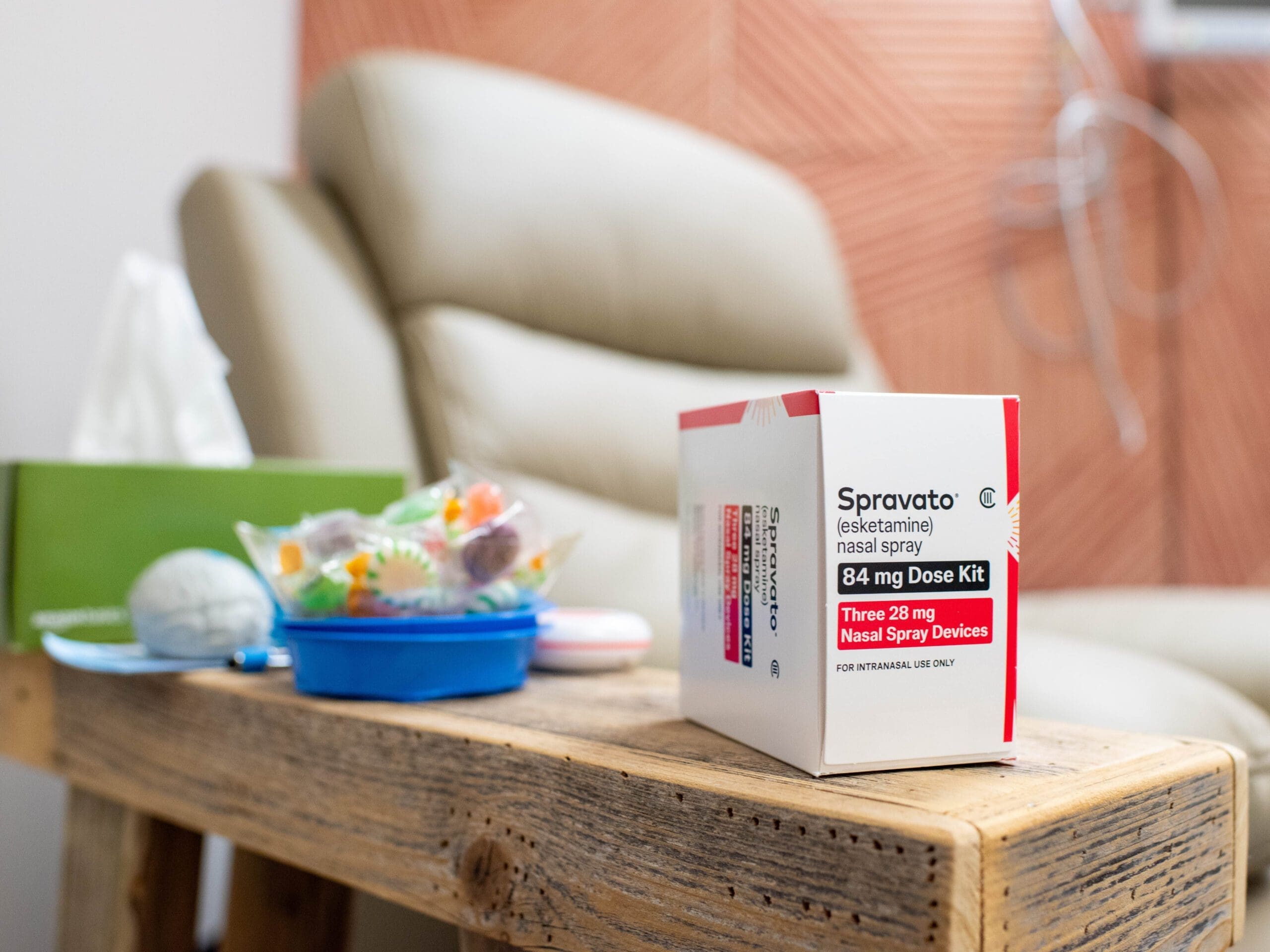
Spravato is an FDA-approved nasal spray that works on a different pathway in the brain than standard antidepressants. You take it in our office under the supervision of our care team. No IVs and no needles.
How Spravato Works
Most oral antidepressants act on the serotonin, norepinephrine, or dopamine systems, and they generally take weeks to build up an effect. Spravato works along a different route entirely. It targets the NMDA receptor, a pathway involved in how the brain forms and adapts its connections.
Because of that difference, some people notice a shift in how they feel sooner than they would with a traditional antidepressant. Everyone responds differently, though, and your care team will track how you are doing over the course of treatment rather than judging it on one session.
Spravato is taken alongside an oral antidepressant rather than instead of one. It is an addition to your plan, not a replacement for it.
Who Spravato Is For
Spravato is FDA-approved for adults in two situations: treatment-resistant depression, meaning depression that has not responded well to at least two other antidepressants, and major depressive disorder in adults who are experiencing suicidal thoughts.
You have given at least two antidepressants a fair trial
Depression is affecting work, school, or relationships
You are already taking an oral antidepressant
You can manage sessions that run about two and a half hours
The only way to know whether it is a reasonable fit is a conversation with one of our providers, who will look at your full history and what you have already tried.
If You Need Support Right Now
Getting an appointment takes time, and you do not have to wait alone. These lines are free, confidential, and available around the clock.
988 Suicide and Crisis Lifeline. Call or text 988, any time, day or night.
Crisis Text Line. Text HOME to 741741 to reach a trained counselor.
If you are having thoughts of harming yourself, call 988 or go to the nearest emergency room.
What to Expect at Your Appointment
ABOUT TWO AND A HALF HOURS, INCLUDING MONITORING
Most of that time is spent resting comfortably while our team keeps an eye on how you are doing.
01
Arrange your ride first
You will not be able to drive afterward, so bring someone or sort out transport before your appointment.
02
You give the dose yourself
You self-administer the nasal spray in our office, with a member of our care team present throughout.
03
Then you rest
You stay with us in a calm, comfortable space while we monitor you. Bring headphones or music if that helps you settle.
04
What you may feel
Temporary drowsiness, dizziness, or a brief sense of detachment are common, and they ease as the session goes on.
05
Home and rest
You should not drive until the day after your session, following a good night of sleep.
06
Tell us how it went
Your feedback after each session shapes the next one. Nothing you report is too small to mention.
A Typical Treatment Schedule
A full course usually runs about eight to nine weeks, though the exact shape depends on your history and how you respond.
Weeks 1 to 4
Two sessions per week as you begin treatment and your team learns how you respond.
Month 2
One session per week as treatment continues and the schedule eases.
Ongoing
Your provider adjusts the plan based on how you are doing, rather than running a fixed protocol.
The twice weekly stretch at the start is the biggest commitment. It is worth thinking through transport and time off before you begin, and our team can help you plan around it.

Why Choose A Ray of Hope
Spravato is not a standalone treatment. It works alongside an oral antidepressant and usually alongside therapy, so the practice providing it should be able to manage all of that rather than just the dose.
Sessions supervised by our psychiatric providers
Your prescriber is in the same practice
A calm, comfortable setting for your session
Therapy available in the same building
Other options such as Deep TMS if this one is not a fit
If Spravato turns out not to suit your situation, that is not the end of the conversation. There are other routes, and they are here too.
Find the Right Provider
Spravato starts with a psychiatric evaluation. Bring a list of the antidepressants you have already tried if you can, since that history is what the decision rests on.
Ready to Talk About Spravato?
Spravato starts with a psychiatric evaluation. Call the office nearest you and our team will walk you through whether it fits your situation.
Monday to Thursday 8 to 5, Friday 8 to 4. Phoenix 8 to 6, Friday until 4:30 MST.

© 2026 A Ray of Hope Neurology and Psychiatry. All rights Reserved - Accessibility Statement - Privacy Policy - Sitemap
Managed and Designed by 

NOW ACCEPTING NEW PATIENTS
Child and Adolescent Psychiatry
Board certified child psychiatrist with appointment openings now!
Call (847) 816-6335 Meet Christian Schmidt, MD