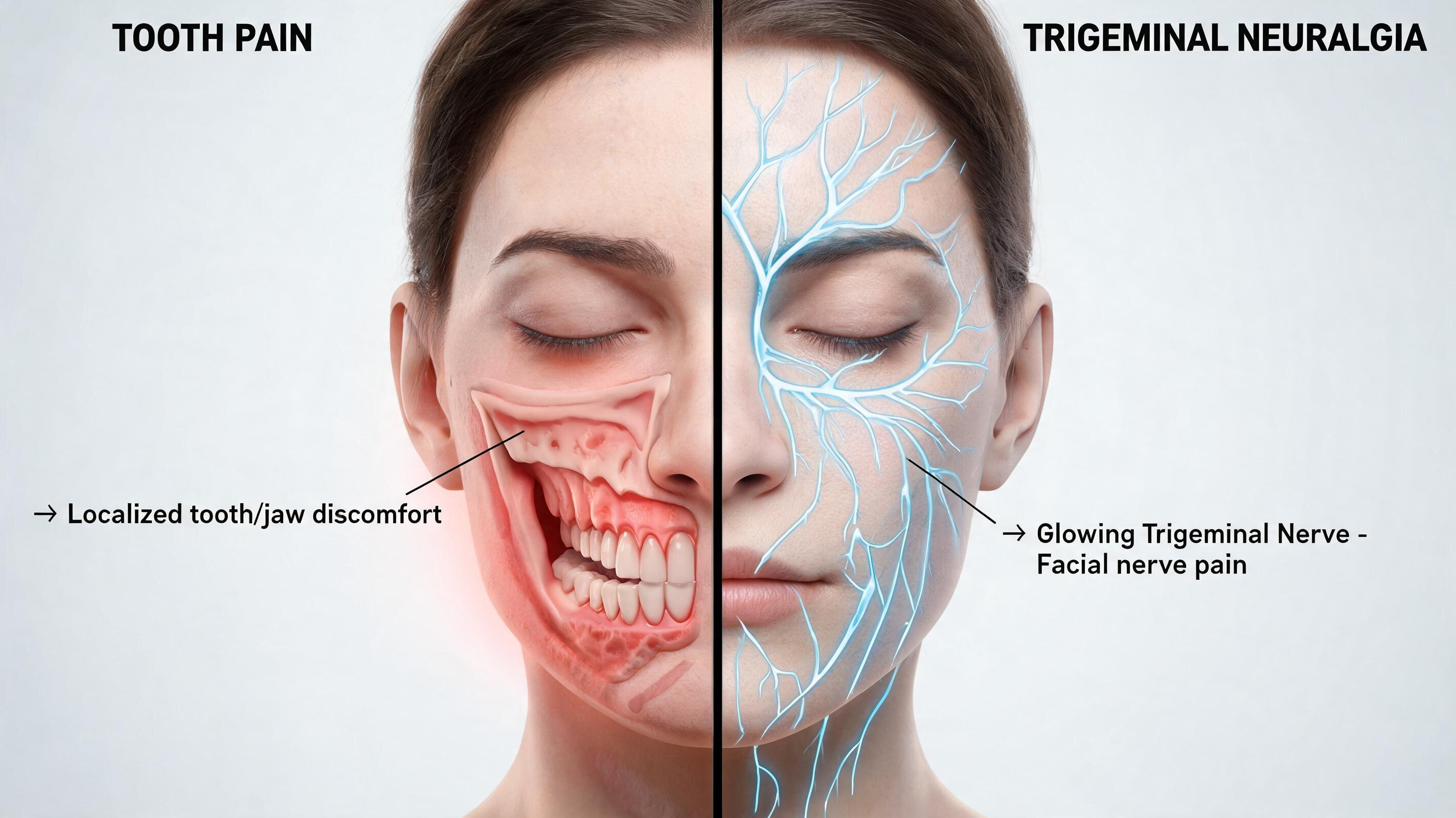
Trigeminal Neuralgia vs. Tooth Pain: How to Tell the Difference and Find the Right Treatment
When “Tooth Pain” Isn’t Really About the Tooth
Pain that feels like it’s coming from a tooth almost always pushes people in one direction: straight to the dentist. And most of the time, that’s the right move. Cavities, cracked teeth, infections, these are common, and they hurt in very familiar ways.
But every so often, the usual story goes off-script.
Some people sit through multiple dental appointments, have X‑rays done, try root canals, or even lose a tooth that looked suspicious… only to discover later that the tooth was never the problem. The real issue was a nerve supplying sensation to the face.
That’s the maddening reality of trigeminal neuralgia. It’s less common than everyday dental problems, but it’s notorious for pretending to be one. Understanding trigeminal neuralgia vs. tooth pain isn’t about diagnosing yourself on Google; it’s about recognizing when the standard explanation stops making sense, so you can move toward the right specialist instead of staying stuck.
How the Brain Can Misread Pain
One of the strange things about pain is that the brain doesn’t always identify the source correctly. It’s reacting to signals, interpreting patterns, and sometimes it gets the “address” wrong.
The trigeminal nerve is the main wiring for sensation across much of the face. It carries feeling from the cheeks, jaw, lips, gums, and yes, the teeth. When this nerve becomes irritated, compressed, or damaged, the brain may interpret those signals as pain in a specific tooth, even if the tooth itself is perfectly healthy.
That’s why someone with trigeminal neuralgia can tap one tooth with absolute conviction and say, “It’s this one. I’m sure.” The dentist looks, takes X‑rays, checks the gums, and finds nothing that explains the level of pain the person is describing.
The pain isn’t imagined. It’s real. It’s simply mislabelled by a nervous system that isn’t always great at knowing exactly where the alarm started.
Toothache Pain Usually Has a Backstory
Think about the last time you or someone you know had a genuine tooth problem.
Maybe it started with a twinge when drinking something cold. Maybe a particular tooth had been sensitive to heat for weeks. The discomfort slowly escalated, from an annoyance to something you couldn’t ignore. Chewing on that side became difficult. There might have been visible decay, swollen gums, or a bad taste that hinted at infection.
True dental pain often behaves like this. It tends to:
Linger rather than appear and vanish in seconds
Worsens when you chew or apply pressure
React predictably to hot or cold
Come with visible changes in the tooth or gums
It has a story, a slow build, a pattern you can almost trace backward.
Trigeminal neuralgia doesn’t always offer that kind of narrative.
Trigeminal Neuralgia: Sudden, Electric, and Unfair
People with trigeminal neuralgia often describe the first attack as completely out of the blue. One moment they’re fine, and the next they’re hit by a bolt of pain across one side of the face. They might be eating lunch, brushing their teeth, drying their face with a towel, or simply talking when it happens. The pain is explosive, sharp, and electric. And then, just as suddenly, it’s gone.
Until it comes back.
If you’ve ever typed “what does trigeminal neuralgia feel like” into a search bar, you’ll notice the same words appear again and again: electric shock, lightning, stabbing. It’s less like a deep ache and more like a violent jolt, brief, intense, and almost impossible to predict.
That’s one of the key differences. Dental pain usually settles in and refuses to leave. Trigeminal neuralgia arrives, attacks, and disappears, leaving behind fear and confusion.
Clues Hidden in Everyday Triggers
One of the biggest hints that you’re dealing with nerve pain rather than a tooth problem is what sets it off.
With a typical toothache, pressure and temperature are the main triggers. Chewing on something hard, biting down, sipping hot coffee, or gulping ice water makes sense as “bad ideas” because they irritate the tooth. , Trigeminal neuralgia can be set off by things that sound almost ridiculous on paper:
Rinse your face with tap water
A light breeze brushing your cheek
Shaving or applying makeup
Smiling for a photo
Saying a few words out loud
Gently touching part of your face
Imagine worrying that washing your face or feeling a cold breeze could cause severe pain. That doesn’t fit the pattern of a cavity or an abscess. It fits a nerve that has become hypersensitive, reacting to even the slightest touch.
The Root Canal That Never Fixed Anything
Neurologists hear a similar story over and over.
A patient develops severe pain near a molar. The dentist, quite reasonably, suspects the tooth. A root canal is done. For a brief time, hope rises.
Then the pain returns.
Another tooth gets examined. Another dentist offers a different opinion. Sometimes another procedure is performed. The cycle repeats.
Only later, sometimes much later, someone finally asks the question no one asked at the beginning: What if the teeth were never the problem?
That doesn’t mean the dental care was unnecessary or careless. The symptoms truly resembled a tooth disorder. It simply shows how convincing trigeminal neuralgia can be when it lives in the same area as the teeth.
Not Every Sharp Pain Means Trigeminal Neuralgia
This is where the internet can make things harder than they need to be.
Reading about trigeminal neuralgia online doesn’t mean you’ve found your diagnosis. Several conditions can mimic dental pain or facial pain, including sinus infections, temporomandibular joint (TMJ) disorders, migraine, muscle tension, and certain headache types.
Likewise, not every episode of sharp, stabbing pain in a tooth points straight to trigeminal neuralgia. The bigger picture matters more than any single symptom: where the pain occurs, how long attacks last, what triggers them, and whether examinations point toward dental or neurological causes.
When the Pattern Stops Looking Dental
Persistent throbbing pain, visible decay, swollen gums, facial swelling, or a fever usually belong on the dental side of the fence. So does hot‑and‑cold sensitivity that lingers long after you eat or drink. Those are signals that something is wrong with the tooth or surrounding tissues, and they deserve prompt dental care.
The situation changes when:
Multiple dental exams keep coming back normal
Treatment doesn’t change the pain at all
Pain arrives in short, explosive bursts rather than a constant ache
Triggers involve light touch, breeze, or routine facial movements
The intensity feels wildly out of proportion to anything visible in your mouth
That’s the point where it becomes reasonable to ask, “Should I see a neurologist for this facial pain?”
What a Neurologist Brings to the Table
Neurologists focus on disorders of the brain and nervous system, including trigeminal neuralgia. When facial pain no longer behaves like a simple tooth problem, they step in to look at the wiring rather than the teeth.
Depending on your symptoms, a neurologist may:
Take a detailed history of how and when the attacks started
Ask about triggers, duration, and what you feel between episodes
Examine facial sensation and nerve function
Recommend imaging, such as an MRI, to look for blood vessels pressing on the trigeminal nerve or other causes.
At A Ray of Hope, the neurology team uses a combination of clinical assessment and advanced diagnostic tools to sort through complex facial pain cases. The goal is not just to put a name on the pain, but to match treatment to the true source.
Why Getting the Diagnosis Right Changes Everything
The biggest difference between “tooth pain” and trigeminal neuralgia isn’t just location. It’s treatment.
An infected tooth may need a filling, root canal, extraction, or antibiotics. Trigeminal neuralgia, on the other hand, is often managed with medications that stabilize nerve activity. Some people eventually benefit from specialized procedures when medication no longer controls the attacks.
Trying to treat trigeminal neuralgia as if it were a dental problem rarely brings lasting relief. Trying to ignore a genuine tooth infection because it “might be the nerve” can be dangerous. Identifying the true source matters more than treating the place where it seems to hurt.
A Pain Worth Taking Seriously
Facial pain is hard to ignore. It touches eating, talking, sleeping, and sometimes even the simple act of smiling.
If your symptoms behave like a typical toothache, a dentist is still the right starting point. But if every dental evaluation says your teeth are healthy while the pain continues, or if the episodes feel more like electric shocks than ordinary toothache, it’s time to widen the search.
At Bansal Neuro- A Ray of Hope, neurologists evaluate conditions such as trigeminal neuralgia with a comprehensive approach. If facial pain has become a recurring part of your life, or if dental treatment hasn’t given you clear answers, a neurological evaluation can help uncover what’s really going on and guide you toward the right treatment.
Learn more or schedule an appointment through the Bansal Neuro contact page.
© 2026 A Ray of Hope Neurology and Psychiatry. All rights Reserved - Accessibility Statement - Privacy Policy - Sitemap
Managed and Designed by 

NOW ACCEPTING NEW PATIENTS
Child and Adolescent Psychiatry
Board-certified child psychiatrist with appointment openings now!
Call (847) 816-6335 Meet Christian Schmidt, MD