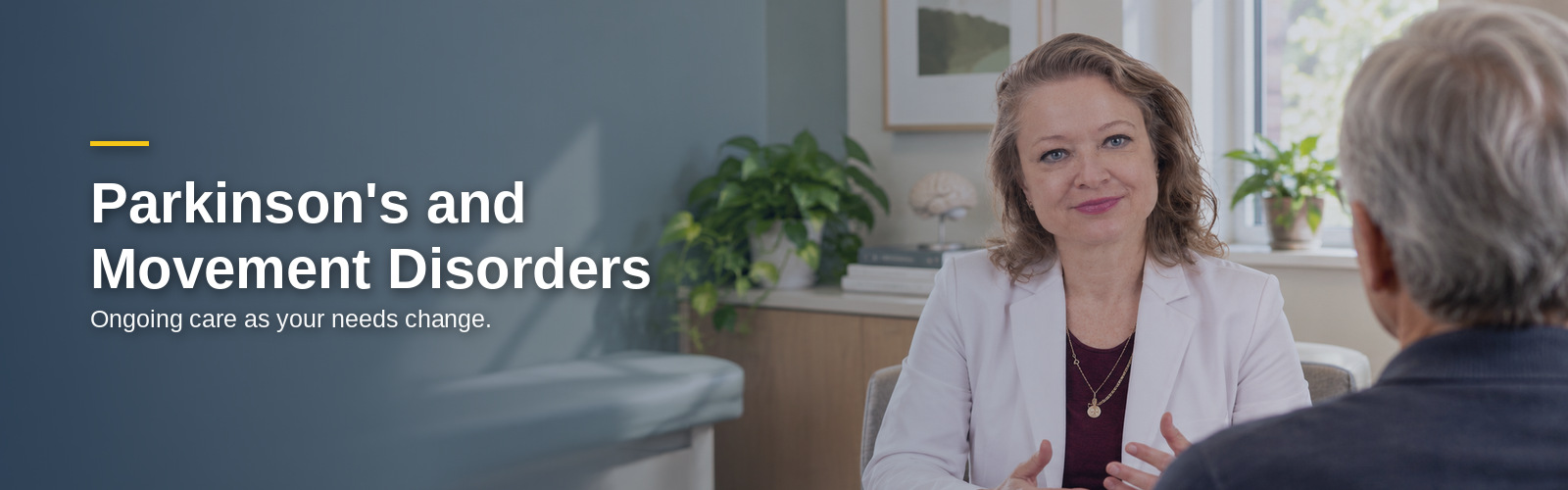
A tremor, a slower walk, handwriting that has quietly shrunk. Early Parkinson's symptoms are subtle enough that many people put them down to getting older, sometimes for a year or more before anyone looks closely.
Our neurologists evaluate tremor and other movement changes, work out whether Parkinson's disease is what is going on, and manage care over the long run. Not every tremor is Parkinson's, and finding out which you are dealing with is the first thing we do.
What Parkinson's Disease Is
Parkinson's is a progressive condition affecting the nerve cells in the brain that produce dopamine, a chemical involved in controlling movement. As those cells decline, movement becomes slower and stiffer, and tremor often appears. It affects roughly one in a hundred people over sixty, though it can begin considerably earlier.
There is no cure, and we are not going to suggest otherwise. What treatment can often do is manage symptoms meaningfully, sometimes for many years, and there is real difference between Parkinson's that is being actively managed and Parkinson's that is not.
Signs Worth Getting Looked At
Symptoms usually begin on one side of the body and come on gradually. Most people notice several of these before anything is diagnosed.
Tremor in a hand at rest
Movement that has become slower
Stiffness in the arms or legs
Balance problems or shuffling steps
Handwriting that has become small
Less facial expression than before
A softer or more monotone voice
Reduced arm swing when walking
Losing your sense of smell
Acting out dreams while asleep
Tremor on its own is not enough to diagnose Parkinson's. Essential tremor is far more common, and there are several other causes. That distinction matters, because the treatments are not the same.

The Symptoms Nobody Warns You About
Parkinson's is described as a movement disorder, and that is where the attention usually goes. But depression, anxiety, disrupted sleep, apathy, and changes in memory or concentration are common alongside it, and for many people they affect daily life more than the tremor does.
These are frequently missed. They get read as an understandable reaction to a hard diagnosis and left alone, when in fact they are part of the condition and often respond to treatment. Anyone can tell you that. What is less common is a practice that can actually do something about it in the same building.
Because psychiatry and therapy are part of A Ray of Hope, mood, sleep, and cognition can be treated alongside the movement symptoms by providers who talk to each other. If memory changes become part of the picture, our memory and dementia care team is in the same practice as well.
How It Is Diagnosed
THERE IS NO SINGLE TEST FOR PARKINSON'S
Diagnosis rests on clinical judgment, built from what you describe and what the exam shows.
01
Your history
When symptoms began, how they have changed, and which side started first. Bring anyone who has noticed changes you have not.
02
A neurological exam
Your provider assesses tremor, muscle tone, walking, balance, and the speed of specific movements. This is where most of the answer comes from.
03
Ruling other things out
Imaging, bloodwork, or a medication review may be used to exclude other causes of tremor and slowed movement.
What Treatment Involves
Medication is the mainstay, most often working by replacing or supporting dopamine. Finding the right combination and timing takes adjustment, and what works well in the first years may need revisiting later. This is why regular follow up matters more in Parkinson's than in many other conditions.
Exercise and physical activity are not an afterthought here. Staying active is one of the few things consistently associated with better long term function, and your provider will talk with you about what that looks like realistically for you. Physical, occupational, and speech therapy all have a role, and we will help arrange those where they are useful.
Some people eventually become candidates for advanced treatments such as deep brain stimulation. If that point comes, we will discuss it and coordinate a referral to the specialist center that handles it.
Care partners deserve mention. Parkinson's is a condition that families live with, and the spouse or adult child at the appointment is carrying real weight. You are welcome to bring them, ask questions, and get support of your own if you need it.
Why Choose A Ray of Hope
Parkinson's is not only a movement problem, and treating it as though it were leaves a great deal on the table. The mood, sleep, and thinking side of this condition is treated here rather than referred out, by people who share your record.
Neurologists evaluating tremor and movement changes
Psychiatry and therapy for the non-motor symptoms
Neuropsychological testing when memory changes appear
Regular follow up as medication needs change
Coordination for therapy and advanced treatment referrals
Support for care partners and family
Find the Right Provider
Evaluation starts with one of our neurologists. Bring a list of your medications and, if you can, someone who has seen the changes alongside you.
Ready When You Are
Choose the office nearest you to request an appointment, or give us a call and we will help you find the right provider.

© 2026 A Ray of Hope Neurology and Psychiatry. All rights Reserved - Accessibility Statement - Privacy Policy - Sitemap
Managed and Designed by 

NOW ACCEPTING NEW PATIENTS
Child and Adolescent Psychiatry
Board-certified child psychiatrist with appointment openings now!
Call (847) 816-6335 Meet Christian Schmidt, MD